What does “5-inch” actually mean in a 5-inch FPV drone?
Many beginners think the measurement refers to the physical size of the drone frame.
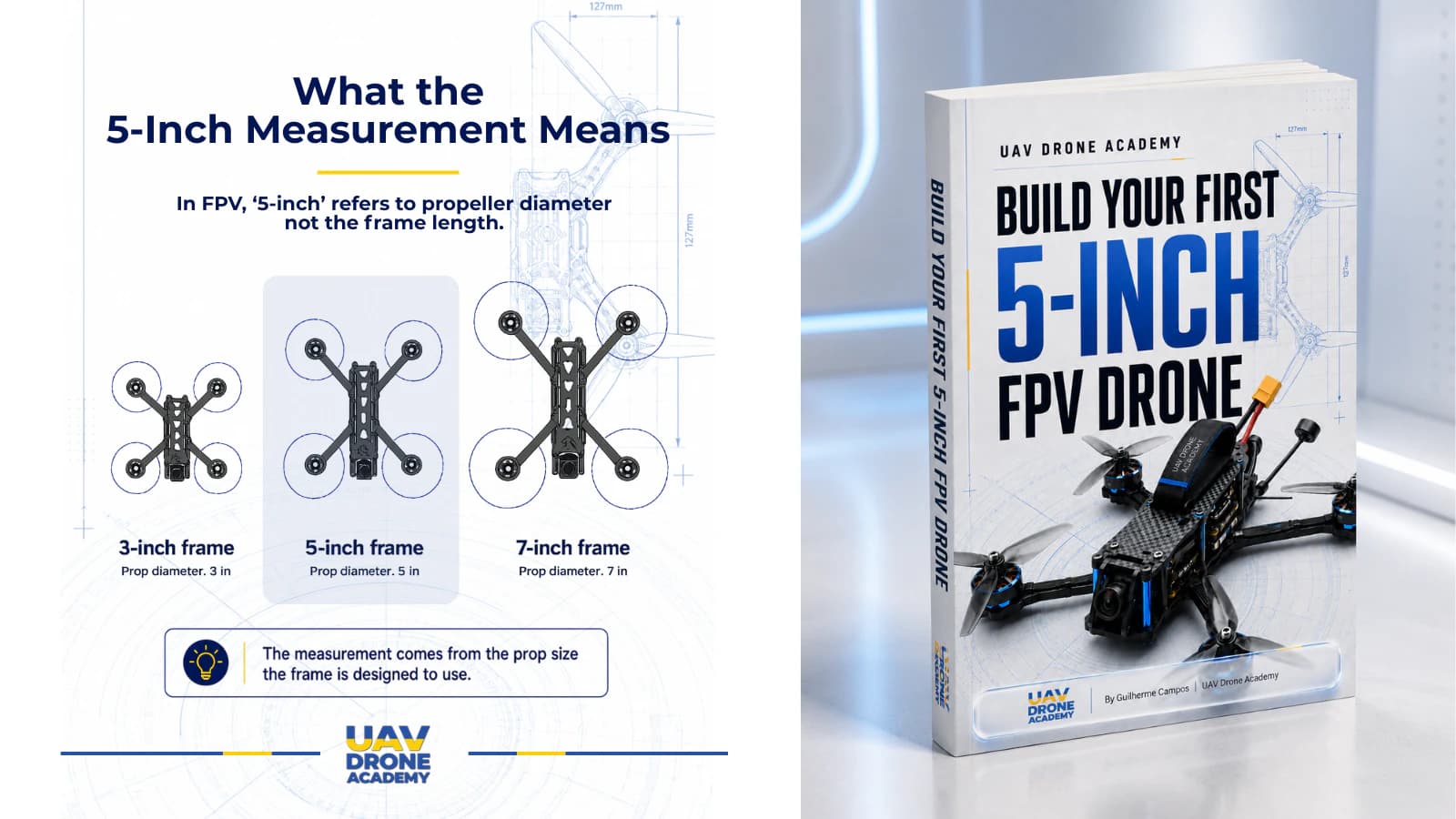
But in FPV, “5-inch” refers to the propeller size — specifically, the approximate diameter of the propellers used on the drone.
That single measurement influences much more than just the propeller.
It affects:
- motor selection
- frame size
- battery choice
- thrust and efficiency
- flight style
- durability
- overall build strategy
Understanding what “5-inch” really means is one of the first steps before choosing parts, building the frame, or configuring your drone.
The “5-Inch” Measurement Refers to Propellers
In a 5-inch FPV drone, the term “5-inch” usually means the drone is designed to use propellers with an approximate diameter of 5 inches.
It does not mean the entire drone is 5 inches wide.
It does not mean the frame is exactly 5 inches long.
It does not mean the drone body measures 5 inches from front to back.
The measurement is based on the propeller size.
This is important because propeller size strongly influences the rest of the build.
A drone designed for 5-inch propellers needs a frame, motors, ESC, battery, and power system that all work well with that propeller size.
Why Propeller Size Matters
The propeller is one of the most important parts of the drone.
It is the component that converts motor rotation into thrust.
A larger propeller can move more air.
A smaller propeller moves less air but may respond faster and require less space.
In FPV, propeller size affects:
- how much thrust the drone can produce
- how responsive the drone feels
- how efficient the build can be
- how much current the motors draw
- how large the frame needs to be
- how heavy the drone can reasonably be
- what battery size makes sense
This is why “5-inch” is not just a small label.
It defines the entire platform.
It Does Not Mean Frame Size
One of the most common beginner misunderstandings is thinking that “5-inch” refers to the frame size.
Frame size is usually measured differently.
Many FPV frames are described by motor-to-motor distance, often measured diagonally in millimeters.
For example, a 5-inch freestyle frame might have a wheelbase somewhere around the typical range needed to safely fit 5-inch propellers.
But the frame is not called “5-inch” because of its wheelbase.
It is called a 5-inch drone because it is designed around 5-inch propellers.
The frame must simply be large enough to provide proper clearance for those props.
How 5-Inch Props Affect Motor Selection
Motor choice depends heavily on propeller size.
A 5-inch propeller needs motors that can spin it efficiently and produce enough thrust without overheating or drawing excessive current.
For typical 5-inch FPV builds, motor selection is influenced by:
- stator size
- KV rating
- battery voltage
- propeller pitch
- target flying style
- total drone weight
This is why you do not choose motors randomly.
The motor and propeller must work together.
A motor that works well on a smaller drone may not be suitable for 5-inch props.
A motor that is too weak may feel underpowered.
A motor that is too aggressive may draw too much current or reduce efficiency.
How 5-Inch Props Affect Frame Design
A 5-inch frame must provide enough space for the propellers to spin safely.
This means the frame needs:
- correct arm length
- enough propeller clearance
- strong arms
- good motor mounting points
- space for electronics
- enough room for battery mounting
- protection for camera and antennas
The frame also needs to handle the forces produced by 5-inch props and powerful motors.
A weak or poorly designed frame can create vibration, flex, or durability problems.
This is why frame selection matters so much in a beginner build.
How 5-Inch Props Affect Battery Choice
A 5-inch FPV drone usually needs a battery that can deliver enough current for powerful motors and propellers.
For many modern 5-inch builds, 6S LiPo batteries are common.
Battery choice affects:
- flight time
- throttle response
- voltage sag
- weight
- balance
- motor load
- overall flight feel
A battery that is too small may sag heavily.
A battery that is too large may make the drone feel heavy.
The goal is balance.
The 5-inch platform became popular because it can carry a practical battery size while still remaining agile and powerful.
Why the 5-Inch Platform Became So Popular
The 5-inch platform became one of the most popular choices in FPV because it offers a strong balance between power, agility, stability, repairability, and versatility.
It is small enough to be practical.
Powerful enough for freestyle.
Fast enough for racing.
Stable enough for cinematic practice.
Flexible enough for future upgrades.
This balance is what makes the 5-inch FPV drone such a strong learning platform.
It is not the smallest drone.
It is not the largest drone.
It sits in a very useful middle ground.
5-Inch FPV for Freestyle
For freestyle, 5-inch drones are extremely popular.
They offer enough power for:
- rolls
- flips
- dives
- power loops
- split-S maneuvers
- fast recovery
- aggressive direction changes
At the same time, they are still repairable and widely supported.
Many frames, motors, props, stacks, and accessories are designed specifically for 5-inch freestyle builds.
This makes the platform beginner-friendly from a parts availability perspective.
5-Inch FPV for Racing
The 5-inch class has also been important in FPV racing.
A 5-inch drone can be fast, responsive, and powerful enough for race tracks.
Racing builds may use different frame geometry, motors, props, and tuning compared to freestyle builds.
But the core idea remains the same:
the platform is built around 5-inch propellers.
This propeller size provides a useful balance between thrust, speed, and control.
5-Inch FPV for Cinematic Practice
A 5-inch FPV drone can also be useful for cinematic practice.
It may not be as smooth or protected as a cinewhoop, and it is not the same as a larger long-range platform.
But it can teach:
- smooth throttle control
- camera angle awareness
- clean lines
- outdoor cruising
- manual FPV control
- basic cinematic movement
For beginners, this makes the 5-inch platform flexible.
You can learn freestyle basics, racing-style control, and cinematic movement on the same general platform.
Why 5-Inch Is a Good Beginner Learning Platform
A 5-inch FPV drone is not the easiest possible drone to fly.
Smaller drones can be less intimidating.
Simulators are safer for first stick practice.
But as a first serious self-built FPV drone, the 5-inch platform has major advantages.
It is:
- widely documented
- supported by many parts
- powerful enough to grow with the pilot
- repairable after crashes
- large enough to work on comfortably
- common in the FPV community
- flexible for different flying styles
This makes it an excellent platform for learning how FPV systems actually work.
The Build Strategy Starts With the Platform
Before choosing individual components, you need to understand the platform.
If you are building a 5-inch FPV drone, every major choice should support that platform.
That includes:
- frame
- motors
- propellers
- ESC
- flight controller
- battery
- FPV camera
- VTX
- receiver
- antennas
- mounting hardware
The goal is not to collect random parts.
The goal is to build a balanced system.
The phrase “5-inch” helps define that system from the beginning.
Common Beginner Mistakes
Thinking 5-Inch Means Frame Size
The measurement refers to propeller diameter, not the physical size of the frame.
Choosing Motors Without Considering Prop Size
Motors must match the propeller size, battery voltage, and build style.
Choosing a Frame Without Checking Prop Clearance
The frame must be designed to safely fit 5-inch props.
Using a Battery That Is Too Heavy
Too much battery weight can make the drone feel slow and reduce agility.
Using a Battery That Is Too Weak
A weak battery may sag under load and reduce performance.
Copying Random Parts Lists Without Understanding the Platform
A parts list only makes sense when the components work together as a system.
What This Means for Beginners
For beginners, the key lesson is simple:
“5-inch” defines the propeller platform.
Once you understand that, many other choices become easier.
You can start asking better questions:
- What frame fits 5-inch props?
- What motors work well with 5-inch props?
- What battery size is appropriate?
- What flying style do I want?
- How much durability do I need?
- How simple should the first build be?
This is the beginning of better FPV decision-making.
Part of the Book
This content is part of our book:
Build Your First 5-Inch FPV Drone │ UAV Drone Academy
A complete beginner’s guide designed to help new pilots understand, build, configure, test, fly, maintain, and upgrade their first 5-inch FPV drone with confidence.
Before you build, understand the platform.
Conclusion
In a 5-inch FPV drone, “5-inch” refers to the approximate diameter of the propellers.
That measurement affects much more than the propeller itself.
It influences:
- motor selection
- frame size
- battery choice
- thrust and efficiency
- flight style
- durability
- overall build strategy
The 5-inch platform became popular because it offers a strong balance between power, agility, stability, repairability, and versatility.
It is practical, powerful, flexible, and widely supported.
For beginners, understanding what “5-inch” really means is one of the first steps toward building a better drone.
Before you choose parts, understand the platform.