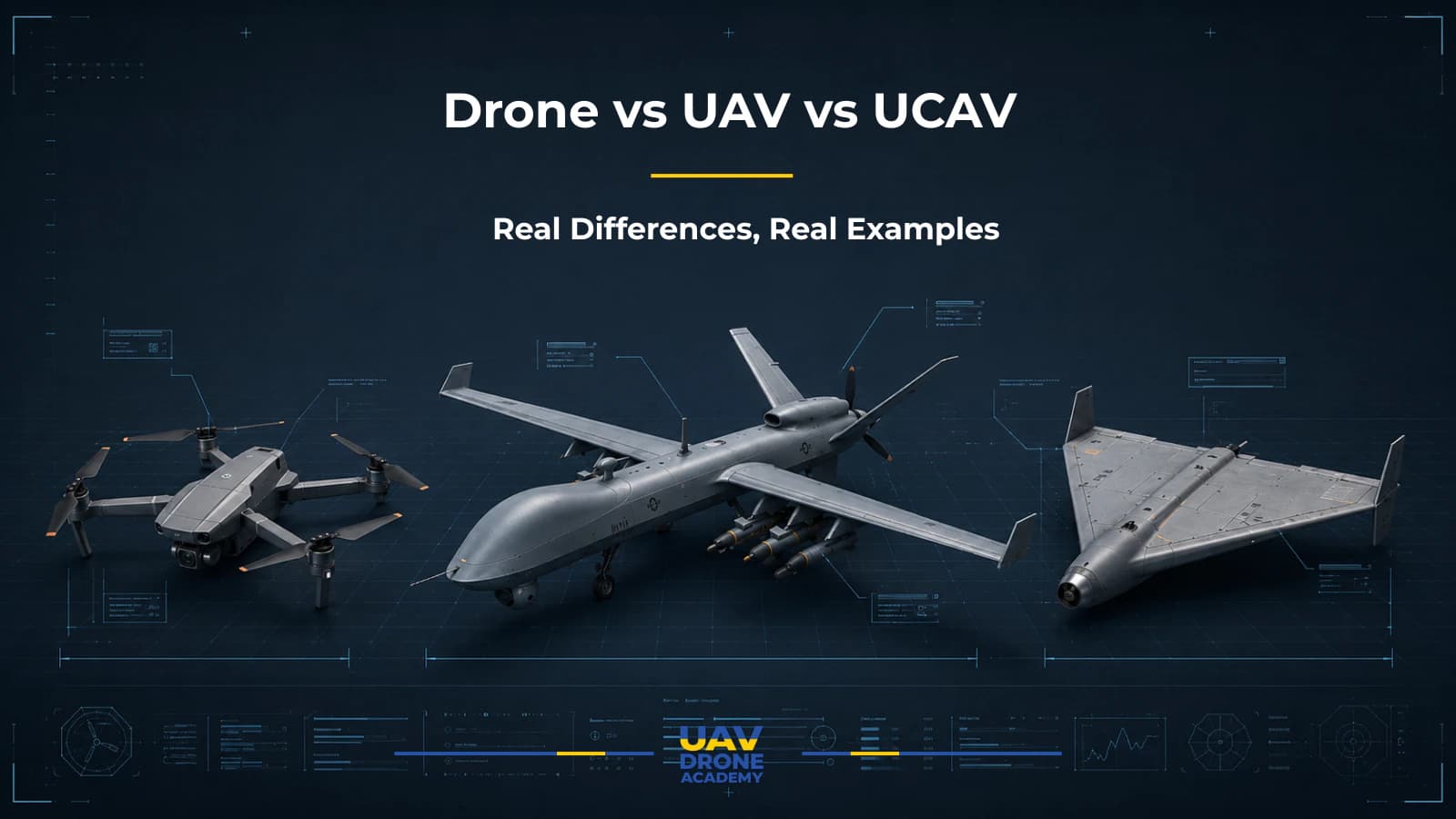
You have seen these three terms used as if they were interchangeable: drone, UAV, and UCAV. They are not, and the confusion is not harmless. The war in Ukraine turned the drone vs UAV vs UCAV distinction from a footnote in engineering textbooks into something that shapes entire combat doctrines, procurement budgets, and design decisions. In this article, you will learn what each term actually means, meet a fourth category that Ukraine pushed into the center of the global military vocabulary, and see real Ukrainian systems that illustrate every one of them — from expendable aircraft that fly 1,600 km and never come back, to reusable platforms that have logged millions of missions and returned home every night.
If you have read Understanding UAV Architecture: Subsystems and Integration, you already know the core thesis of this academy: an unmanned aircraft is an integrated engineering system, and its category is defined by mission logic, not by how it looks. This article applies that same systems thinking to terminology.
Drone vs UAV vs UCAV: The Definitions That Actually Matter
Drone is the popular, generic term. It covers everything from a $50 toy quadcopter to a military aircraft worth millions of dollars. Technically imprecise, but it is the word everyone uses, and there is no point fighting it in casual conversation. In engineering documents, however, precision matters.
UAV (Unmanned Aerial Vehicle) is the correct technical term for the aircraft itself: no pilot on board, controlled remotely or flying autonomously. Here is the detail most people miss — when you include the ground control station, the communication link, and the operator, the whole package becomes a UAS (Unmanned Aircraft System). That distinction is not pedantry. Most real-world failures happen at the system level, in the links between aircraft, radio, and operator, not inside the airframe.
UCAV (Unmanned Combat Aerial Vehicle) is the military attack subcategory. It is a UAV designed specifically to strike: it carries missiles, guided bombs, or droppable munitions. The keyword is reusable. A classic UCAV releases its payload and flies back to base, like a fighter jet without a pilot.
And then there is the fourth category, the one Ukraine industrialized at a scale nobody predicted:
Loitering munition / OWA (One-Way Attack) drone, popularly the "kamikaze drone." This aircraft is the weapon. It flies to the target and destroys itself on impact. Expendable by definition. Technically it is not a UCAV, because it never returns, but it competes for the exact same strike missions.
| Term | What it is | Armed? | Returns from the mission? |
|---|---|---|---|
| Drone | Popular generic term | Depends | Depends |
| UAV | Technical term for the unmanned aircraft | Not necessarily | Usually yes |
| UCAV | Combat UAV, designed to attack | Yes | Yes (reusable) |
| Loitering / OWA | Munition-drone, "kamikaze" | It is the weapon | No (expendable) |
Keep this table in mind, because everything that follows is a real-world stress test of these four boxes.
Ukraine's Expendable Fleet: The One-Way Doctrine
Ukraine answered Russia's Shahed campaigns by building its own family of long-range one-way attack drones, and the underlying logic is brutally simple: if the aircraft never comes back, it can be cheap, structurally simple, and mass-produced. Every design decision flows from that single assumption.
AN-196 Liutyi — the strategic workhorse
Developed by Ukroboronprom in partnership with Antonov, the Liutyi ("Fierce") is Ukraine's most important long-range one-way strike drone. Publicly reported figures put its range at up to 2,000 km in confirmed strikes, with a 50–75 kg warhead and a unit cost around US$ 200,000. Guidance combines autonomous navigation with operator correction and machine-vision terminal targeting. The Liutyi became the protagonist of the so-called "oil war": systematic strikes on refineries and industrial infrastructure deep inside Russian territory, accounting for the majority of successful long-range attacks in 2024.
FP-1 — mass production with a plywood body
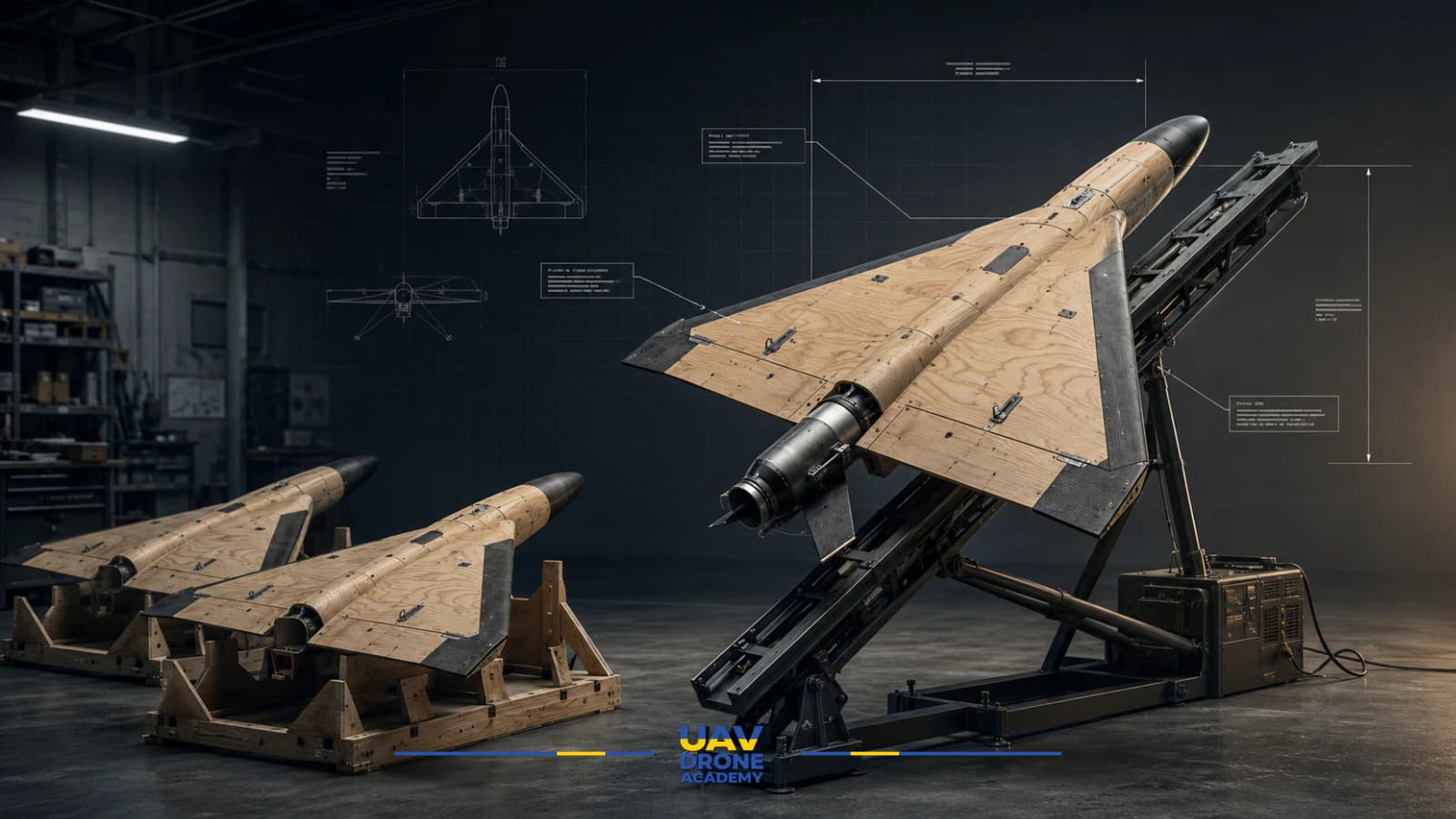
If the Liutyi represents precision, the FP-1 from private company Fire Point represents volume. Presented publicly in 2025, it reaches up to 1,600 km with a warhead of up to 120 kg — and its defining engineering choice is a plywood airframe with simplified guidance, launched by a solid-fuel rocket booster. Reported production runs around 100 units per day. The FP-1 now accounts for most Ukrainian long-range strikes for one reason: the expendable math works. Trading a cheap airframe for a destroyed strategic target is a favorable exchange every single time.
Other notable expendables include the UJ-26 Beaver, used against strategic targets such as airfields including in Crimea; the FP-2, a short-range sibling of the FP-1 with roughly 200 km of range and a 100+ kg warhead optimized against air defense systems; and the AQ-400 Kosa, a project built around ultra-cheap, scalable production.
The Reusable Platforms: When the Drone Has to Come Home
Not every mission justifies destroying the aircraft. For daily tactical combat along the front line, Ukraine relies on reusable platforms — and this is where the concept moves closest to the classic UCAV definition.
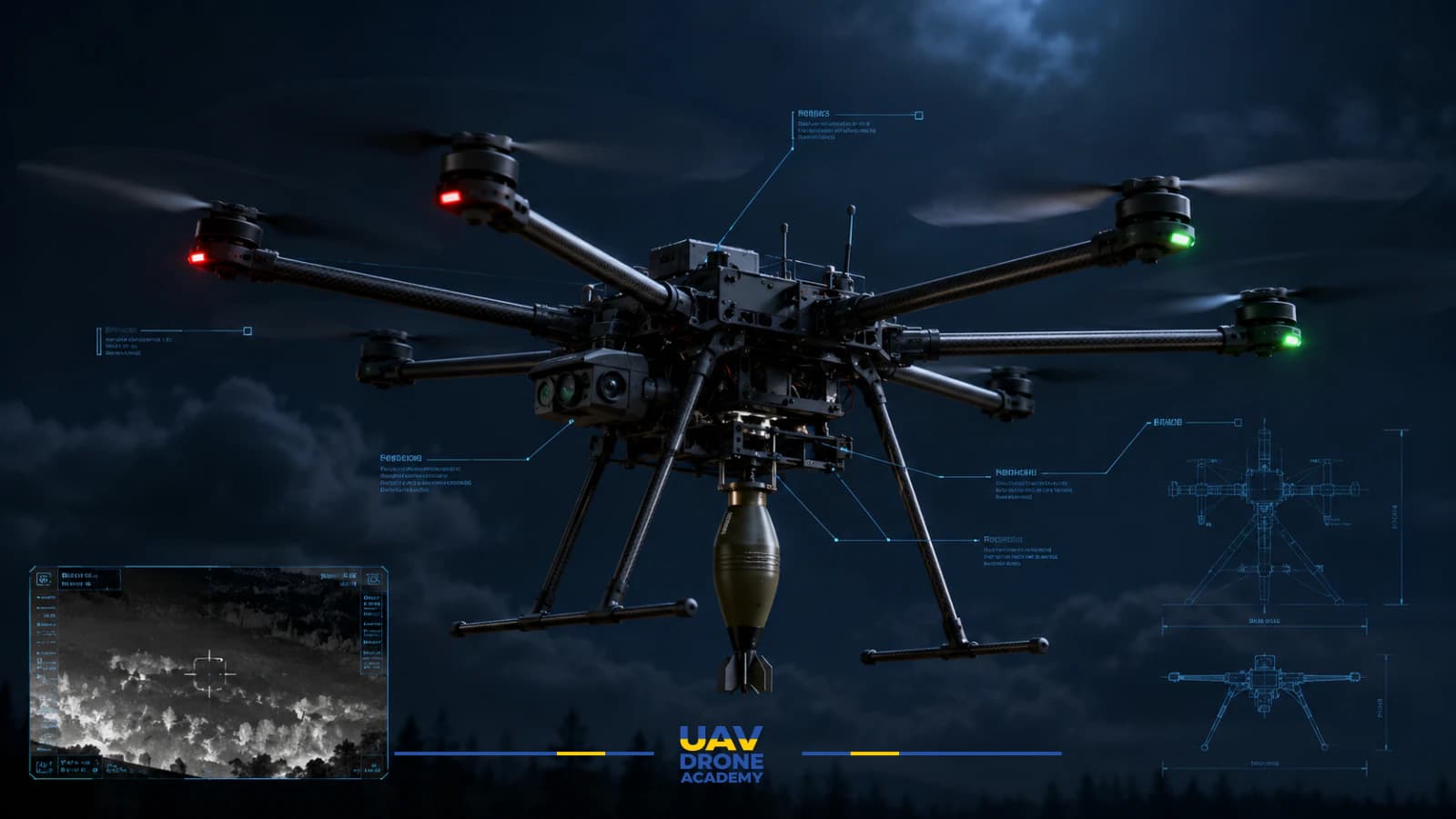
Vampire ("Baba Yaga") — the night bomber
The heavy hexacopter Vampire, built by SkyFall, is probably the most successful reusable drone of the war. Russian troops nicknamed this entire class of heavy bombers "Baba Yaga," after the flying witch of Slavic folklore. The platform carries around 15 kg of payload — mortar rounds, shaped charges, adapted anti-tank mines — with an operational radius from 20 km up to 60 km in recent versions, at a unit cost near US$ 8,500, down from US$ 20,000 in 2022. Its specialty is night operation with thermal cameras.
The Vampire has accumulated more than 2.5 million combat missions and was rated the most effective strike system on the battlefield in 2025 by Ukraine's government drone scoring program. Beyond bombing, it performs remote road mining, logistics resupply for troops, and has even delivered supplies to isolated civilians. The doctrinal point is the heart of this article: because it is reusable, the Vampire justifies thermal sensors, anti-jamming systems, and electronics that would be far too expensive to lose on a single flight. If you understand how those subsystems interact — the same control-link and video-feed logic explained in FPV Drone Signal Flow: Control Link and Video Feed Explained — you understand why hardening those links only pays off on an airframe that flies hundreds of times.
Other reusable platforms worth knowing: the R18 from Aerorozvidka, the pioneering octocopter of the class, born from a volunteer engineering project; the Kazhan from Reactive Drone, carrying 15–20 kg with combat range up to 25 km; and the Bayraktar TB2, the Turkish fixed-wing platform that became the textbook UCAV example early in the war — firing guided munitions and returning to base — even though dense air defenses have since reduced its role. The UJ-22 Airborne is the fascinating boundary case: the same aircraft can operate as a reusable munition-dropping platform or be configured as a one-way kamikaze. One airframe, two doctrines.
What This Teaches Drone Engineers
Ukraine proved that the split between expendable and reusable is not about technology. It is about economics and doctrine. An expendable OWA drone is cheap, simple, and produced by the thousands — the mission is worth more than the platform, which makes it ideal for saturating defenses and striking deep. A reusable platform costs more per unit but amortizes that cost across hundreds or thousands of missions, which justifies advanced sensors and serious operator training.
For an engineer, each category demands completely different design decisions. An FP-1 accepts a plywood body because it will fly exactly once; a Vampire needs maintenance schedules, inspection checklists, and a field workshop because it will fly thousands of times. The component-selection logic we teach for a first build in Main Components Needed to Build a 5-Inch FPV Drone scales directly into this world: every part choice is a bet on how long the airframe needs to survive.
Frequently Asked Questions
What is the difference between a drone, a UAV, and a UCAV?
Drone is the popular generic term for any unmanned aircraft. UAV is the correct technical term for the aircraft itself, and UCAV is a combat UAV designed to attack and return to base. A UCAV is always a UAV, but most UAVs are not UCAVs.
Is a kamikaze drone a UCAV?
Technically, no. A kamikaze drone is a loitering munition or one-way attack (OWA) drone: it destroys itself on impact and never returns. A UCAV is reusable by definition — it releases its weapons and flies home, like the Bayraktar TB2.
What is the difference between UAV and UAS?
UAV refers only to the aircraft. UAS (Unmanned Aircraft System) includes the full system: the aircraft, the ground control station, the communication link, and the operator. Engineers use UAS when discussing the complete operational package.
Why does Ukraine use both expendable and reusable drones?
Because each solves a different economic problem. Expendable drones like the FP-1 are cheap enough to trade one airframe per strategic target. Reusable platforms like the Vampire amortize expensive sensors and anti-jamming hardware across thousands of missions on the front line.
The 30-Second Summary
Drone is the popular word; UAV is the technical term for the aircraft; UCAV is a reusable combat UAV like the Bayraktar TB2; and loitering or OWA drones like the Liutyi and FP-1 are expendable munition-drones. Ukraine operates both models at massive scale and demonstrated that choosing between them in the drone vs UAV vs UCAV landscape is an economic and doctrinal decision first, and a technical one second. Want to master drones for real, from the 5-inch FPV build to the concepts driving the defense industry? Keep following UAV Drone Academy.