After studying each major subsystem of a 5-inch FPV drone, we can now bring everything together into one complete beginner-friendly parts list.
This is an important step because building an FPV drone is not only about choosing good parts.
It is about choosing parts that work well together.
A beginner build should be:
- reliable
- simple
- repairable
- affordable
- widely supported
- easy to understand
The goal is not to build the most extreme drone possible.
The goal is to build a balanced 5-inch FPV drone that helps beginners learn correctly from the beginning.
In this chapter, we will organize the complete parts list for our beginner-friendly 5-inch FPV build.
What This Parts List Is For
This parts list is designed for a:
5-inch freestyle FPV drone
This type of drone is ideal for learning because it offers a strong balance between:
- power
- stability
- agility
- durability
- community support
- parts availability
A 5-inch FPV drone is large enough to be powerful and capable, but still small enough to be practical for training, repairs, and upgrades.
Our Beginner Build Philosophy
Before looking at individual parts, it is important to remember the philosophy behind this project.
We are not choosing parts only because they are popular or expensive.
We are choosing parts because they support:
- practical learning
- predictable flight behavior
- easy maintenance
- long-term upgrade potential
- beginner-friendly troubleshooting
This matters because a beginner drone will crash.
Parts may break.
Mistakes will happen.
That is normal.
A good beginner build should make the learning process easier, not more frustrating.
Main Components of a 5-Inch FPV Drone
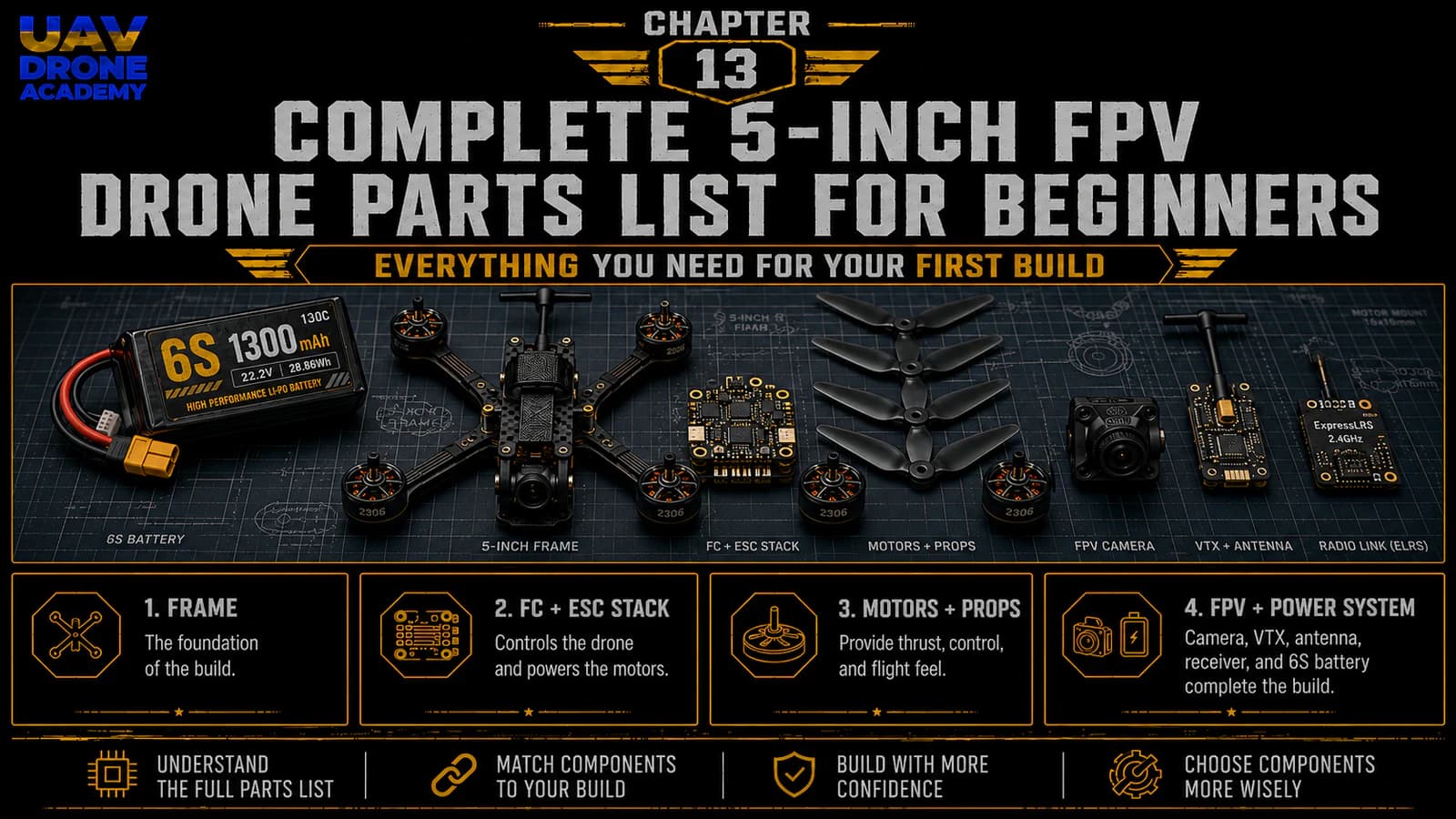
A complete 5-inch FPV drone usually includes:
- frame
- motors
- propellers
- flight controller
- ESC
- FPV camera
- video transmitter
- video antenna
- radio receiver
- battery
- battery strap
- XT60 power connector
- capacitor
- screws and hardware
Each part has a specific role inside the aircraft.
Together, they form one complete flying system.
Frame
The frame is the physical structure of the drone.
It supports:
- motors
- electronics
- battery
- camera
- antenna mounts
- protective structure
For a beginner 5-inch build, the frame should be:
- strong
- simple
- easy to repair
- compatible with common parts
- widely available
A good beginner frame should use replaceable arms.
This is important because arms are often the first parts damaged during crashes.
Recommended Frame Characteristics
For our beginner build, we want a frame with:
- 5-inch propeller compatibility
- carbon fiber construction
- replaceable arms
- enough internal space for electronics
- standard mounting patterns
- good community support
A simple freestyle frame is usually better than an exotic or ultra-light racing frame.
Freestyle frames are generally easier to build, easier to repair, and more forgiving for beginners.
Motors
Motors convert electrical energy into mechanical rotation.
They spin the propellers and generate thrust.
For a 5-inch FPV drone, motor choice affects:
- power
- efficiency
- throttle response
- flight feel
- durability
For our beginner-friendly 6S build, we want motors that are powerful enough for freestyle but not unnecessarily extreme.
Recommended Motor Type
A common and balanced choice for 5-inch 6S freestyle builds is:
2207 or 2306 motors
For KV, a beginner-friendly 6S setup usually works well around:
1700KV to 1900KV
This range provides a good balance between:
- smooth throttle response
- strong power
- manageable control
- good efficiency
The goal is not maximum aggression.
The goal is controlled power.
Propellers
Propellers are responsible for converting motor rotation into thrust.
They directly affect:
- grip
- efficiency
- noise
- control
- throttle feel
- motor load
For beginners, propellers should be simple, common, and easy to replace.
Recommended Propeller Type
For a beginner 5-inch freestyle build, a good starting point is:
5-inch tri-blade propellers
Tri-blade props are very common in freestyle FPV because they provide:
- good grip
- stable control
- predictable handling
- strong community support
Beginners should avoid starting with overly aggressive propellers.
A moderate-pitch propeller is usually easier to control and more forgiving.
Flight Controller
The flight controller is the brain of the drone.
It receives information from sensors and pilot commands, then controls how the drone responds.
The flight controller connects to:
- receiver
- ESC
- FPV system
- motors through the ESC
- battery voltage monitoring
- optional accessories
For beginners, the flight controller should be reliable, well documented, and compatible with modern FPV firmware.
Recommended Flight Controller Features
For a beginner 5-inch build, the flight controller should ideally include:
- Betaflight compatibility
- enough UARTs for receiver and peripherals
- gyro support
- voltage monitoring
- current monitoring
- standard mounting pattern
- clear wiring documentation
The most important point is simplicity.
A well-supported flight controller is better than a complicated board with features the beginner does not need yet.
ESC
ESC means:
Electronic Speed Controller
The ESC controls how much power goes to each motor.
In modern 5-inch FPV drones, builders commonly use a:
4-in-1 ESC
This means one board controls all four motors.
Recommended ESC Type
For a beginner 6S build, the ESC should support:
- 6S batteries
- enough current for 5-inch freestyle motors
- reliable firmware
- strong build quality
- clean wiring to the flight controller
A common beginner-friendly range is around:
45A to 60A
This gives enough headroom for a normal 5-inch freestyle setup.
Flight Controller and ESC Stack
Many modern builds use a matched:
flight controller and ESC stack
This means the flight controller and ESC are designed to work together.
For beginners, this is often a good choice because it reduces:
- wiring confusion
- compatibility problems
- setup complexity
A matched stack usually includes a cable connecting the ESC to the flight controller.
This makes the build cleaner and easier to understand.
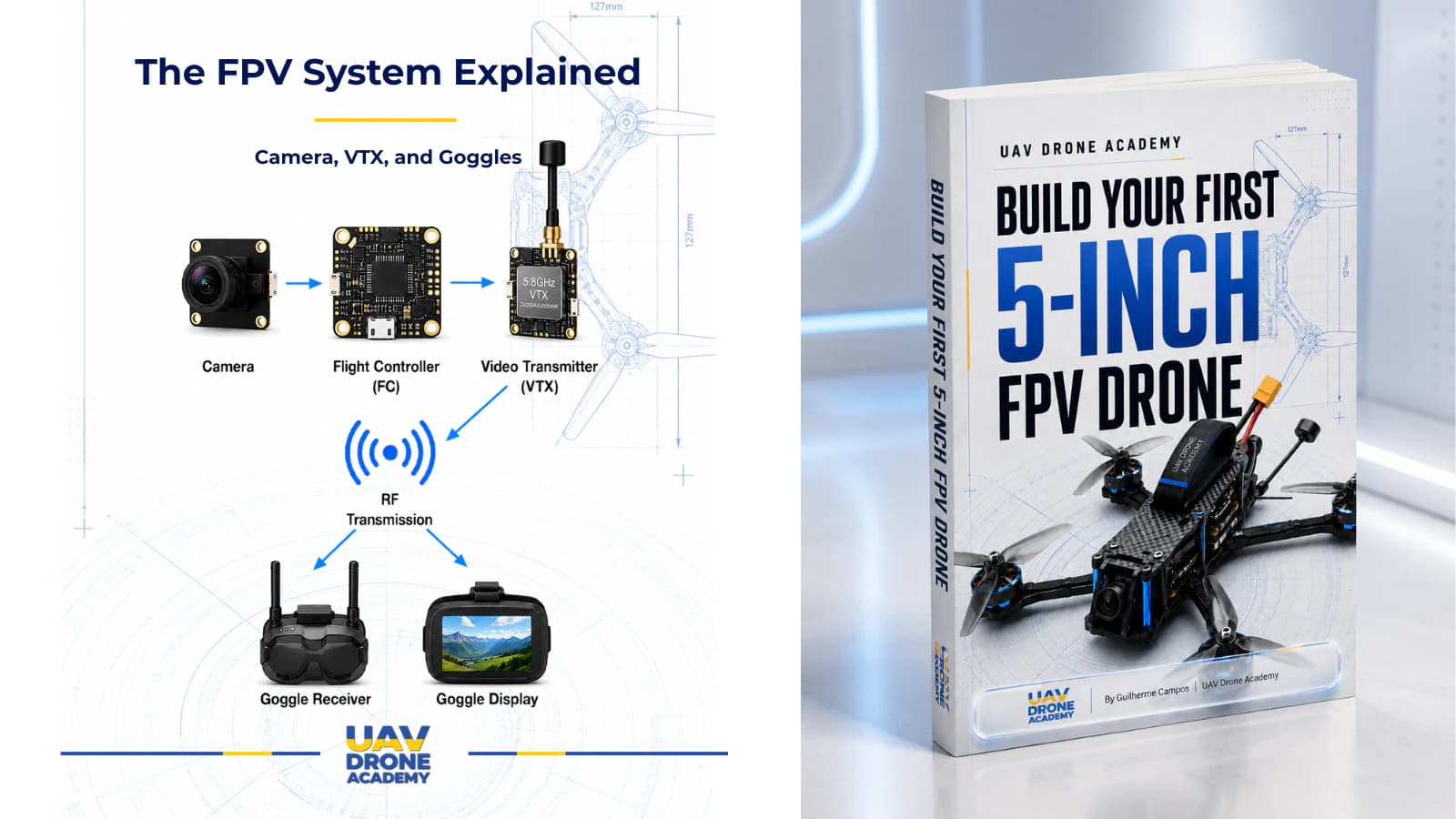
FPV Camera
The FPV camera captures the live video image from the drone.
For an analog beginner build, the camera should be:
- low latency
- durable
- easy to mount
- compatible with the frame
- good enough in changing light conditions
The FPV camera does not need to be the most expensive option.
It needs to provide a reliable image so the pilot can fly confidently.
Video Transmitter
The video transmitter, or VTX, sends the camera signal wirelessly to the pilot’s goggles.
For an analog FPV build, the VTX is one of the most important parts of the video system.
A beginner-friendly VTX should offer:
- reliable signal
- adjustable power levels
- good cooling
- common mounting options
- easy configuration
The VTX must also be compatible with the antenna connector and the frame layout.
FPV Antenna
The FPV antenna affects video signal quality.
A poor antenna can reduce:
- range
- penetration
- image stability
- overall video reliability
For analog FPV, antenna polarization matters.
The important point is to keep the antenna system consistent.
If the goggles use RHCP antennas, the drone should also use RHCP.
If the goggles use LHCP antennas, the drone should also use LHCP.
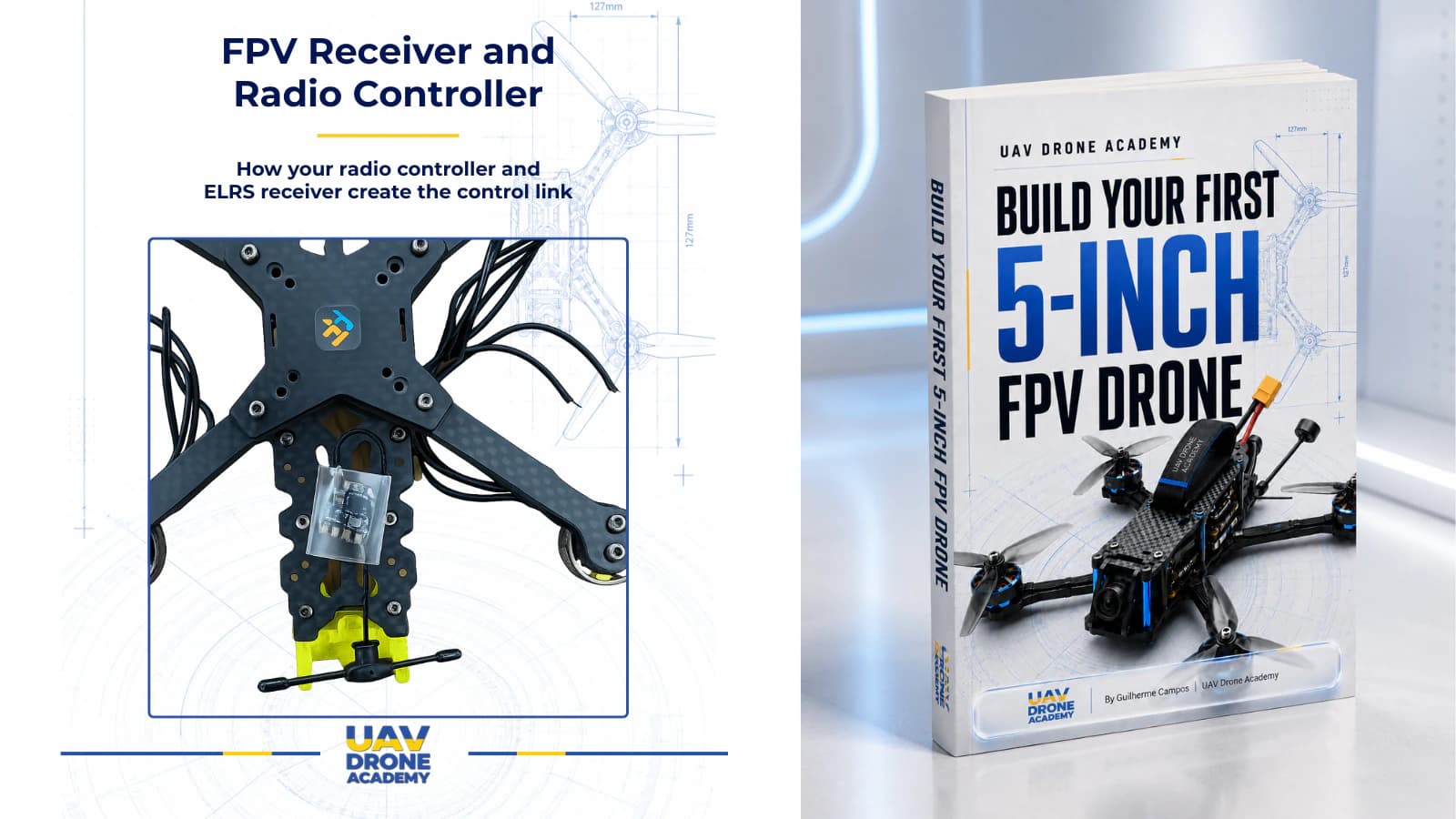
Radio Receiver
The radio receiver allows the drone to receive commands from the pilot’s radio controller.
For our beginner build, we are choosing:
2.4GHz ExpressLRS
This gives us a strong balance of:
- low latency
- reliability
- small antennas
- affordability
- modern compatibility
- community support
A compact ELRS receiver is ideal for this type of build.
Receiver Antenna Placement
The receiver antenna should be mounted carefully.
Good antenna placement helps improve:
- signal quality
- range
- reliability
- control link stability
Avoid placing the receiver antenna too close to carbon fiber, power wires, or other components that may block or interfere with the signal.
A clean antenna layout makes the drone more reliable.
Battery
The battery powers the entire drone.
It affects:
- flight time
- weight
- throttle response
- voltage stability
- agility
- overall flight feel
For our beginner-friendly 5-inch freestyle build, we are using a:
6S LiPo battery
Recommended Battery Size
A balanced beginner battery range is:
1100mAh to 1300mAh
This range provides a good compromise between:
- flight time
- weight
- agility
- control
- durability
Very large batteries may increase flight time, but they also make the drone heavier and less responsive.
For beginners, balance matters more than maximum flight time.
Battery Connector
Most 5-inch FPV drones use:
XT60 connectors
The XT60 became standard because it provides:
- reliable connection
- good current handling
- durability
- wide compatibility
The drone’s power lead and battery connector must match.
Capacitor
A capacitor is usually connected near the battery input.
Its job is to help reduce electrical noise and voltage spikes.
This can protect electronics and improve system stability.
For a 6S 5-inch build, a low ESR capacitor is commonly used.
The exact value depends on the stack and manufacturer recommendation, but including a capacitor is considered good practice.
Battery Strap and Battery Pad
The battery must be mounted securely.
A good battery setup usually includes:
- strong battery strap
- non-slip battery pad
- correct battery position
- clean cable routing
This matters because the battery should not move during flight.
If the battery shifts, the drone’s center of gravity changes.
That can affect flight behavior.
Hardware and Small Parts
A complete build also needs small hardware items.
These may include:
- screws
- standoffs
- motor screws
- zip ties
- heat shrink
- double-sided tape
- antenna mounts
- battery pads
- spare propellers
Beginners should not ignore these small parts.
A build can be delayed simply because one small screw, strap, or connector is missing.
Essential Tools
To build and maintain a 5-inch FPV drone, beginners should have basic tools.
Useful tools include:
- soldering iron
- solder
- flux
- wire cutters
- hex drivers
- tweezers
- smoke stopper
- multimeter
- heat shrink
- small pliers
A good soldering setup is especially important.
Poor soldering can create serious reliability problems.
Beginner-Friendly Complete Parts List
A balanced beginner 5-inch FPV build may include:
- 5-inch freestyle frame
- 4 × 2207 or 2306 motors
- 5-inch tri-blade propellers
- flight controller and ESC stack
- analog FPV camera
- analog video transmitter
- FPV antenna
- 2.4GHz ExpressLRS receiver
- 6S LiPo battery
- XT60 power lead
- low ESR capacitor
- battery strap
- battery pad
- spare propellers
- basic mounting hardware
This list gives us the foundation for a complete beginner-friendly FPV drone.
What Beginners Should Prioritize
When choosing parts, beginners should prioritize:
- compatibility
- reliability
- availability
- documentation
- community support
- repairability
A part that is easy to replace and well documented is often better than a part with slightly better specifications but poor support.
Compatibility Matters
FPV parts must work together.
Before buying parts, always check:
- frame size
- motor mounting pattern
- propeller size
- battery voltage compatibility
- ESC current rating
- flight controller mounting pattern
- receiver protocol
- antenna connectors
- VTX mounting and power requirements
Many beginner problems come from parts that are individually good but not compatible with each other.
Avoiding Overcomplicated Builds
Beginners should avoid making the first build too complex.
It is better to avoid adding too many optional systems at the beginning, such as:
- GPS
- buzzer systems
- LED systems
- digital HD upgrades
- long-range accessories
- advanced telemetry modules
These can be added later.
The first goal is to build a clean, reliable drone that flies correctly.
Common Beginner Mistakes
Buying Parts Before Understanding Compatibility
Many beginners buy parts too quickly.
This can lead to mismatched components and unnecessary frustration.
A parts list should be checked as one complete system.
Choosing Extreme Components
The most powerful motor, highest C-rating battery, or strongest VTX is not always the best beginner choice.
Extreme components can make the drone harder to control and more expensive to repair.
Forgetting Small Parts
Small parts are easy to overlook.
But items like straps, screws, antenna mounts, heat shrink, and spare props are essential.
Ignoring Repairability
A beginner drone should be easy to repair.
Crashes are part of learning.
Choose parts that can be replaced without rebuilding the entire drone.
Not Buying Spare Propellers
Propellers are consumable parts.
They break often.
Beginners should always have spare props ready.
Why This Build Makes Sense
This beginner build makes sense because it is based on balance.
It combines:
- a durable 5-inch frame
- modern 6S power
- practical freestyle motors
- common propellers
- reliable flight electronics
- analog FPV video
- ExpressLRS control link
- beginner-friendly battery size
Nothing is unnecessarily extreme.
Nothing is selected only for marketing numbers.
Every component supports the same goal:
a reliable learning platform.
Our Build Philosophy Moving Forward
At this point, the full logic of the project is clear.
We are building a drone that helps beginners understand FPV from the inside out.
That means learning:
- how each system works
- why each component matters
- how parts connect
- how choices affect flight behavior
- how to troubleshoot problems later
This is much more valuable than simply copying a random parts list online.
Conclusion
A complete 5-inch FPV drone is a system made of many connected parts.
The frame provides structure.
The motors and propellers generate thrust.
The flight controller and ESC control movement.
The FPV system provides live video.
The ExpressLRS receiver connects the pilot to the aircraft.
The battery powers everything.
When these parts are chosen carefully, the result is a drone that is:
- reliable
- balanced
- repairable
- beginner friendly
- ready for future upgrades
This is the foundation of our beginner 5-inch FPV build.
Now that we have a complete parts list, the next step is preparing for the actual build process: tools, workspace, soldering practice, safety habits, and the correct order of assembly.
Next Chapter
FPV Drone Build Preparation: Tools, Workspace, Soldering, and Safety